

Corrosion Risk Assessment Silver Scale ™
Overview of Silver Scale ™
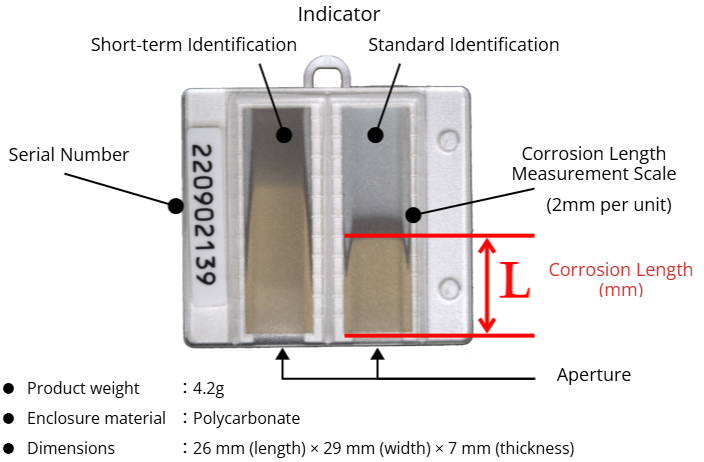
■Capabilities of Silver Scale™
Corrosion risks (hydrogen sulfide and sulfur) can be visually identified.
The corrosion category in compliance with ISO 11844-1 is determined based on the installation period and corrosion length of the Silver Scale™.
This allows for the estimation of the silver sulfidation corrosion rate and hydrogen sulfide gas concentration.
Assess the impact of the corrosion category on equipment.
(Reference: ISO 11844-1 standard, ANSI/ISA 71.04-2013 standard)
| Indoor Corrosion Categories | Impact on equipment | |
|---|---|---|
| IC1 | - Very low indoor corrosivity | - Environment sufficiently controlled to ensure that corrosion is not a factor in determining equipment reliability |
| IC2 | - Low indoor corrosivity | |
| IC3 | - Moderate indoor corrosivity | - Environment where corrosion may be a factor in determining equipment reliability |
| IC4 | - High indoor corrosivity | |
| IC5 | - Very high indoor corrosivity | - Environment where the probability of corrosion attack is high |
| Before evaluation | IC2 (Corrosion Risk: Low) |
IC5 (Corrosion Risk: Very High) |
|
|---|---|---|---|
| Silver Scale |
|
|
|
| Silver Plate (400x) |
|
|
|
| LED Top: 40x Bottom: 100x |
|
|
|
|
|
|
|
Comparison with existing methods
| Silver Scale ™(Visual method) | Standard methods(ISO11844-1) | |
|---|---|---|
| Summary | Evaluate and diagnose corrosion risks based on corrosion length |
Diagnose the corrosion risks based on the corrosion thickness of the metal plate measured by an analyzer |
| Advantages | Visual diagnosis of corrosion risks Remote diagnosis (identifiable through photos, etc.) Cost-effective |
Highly accurate analysis due to the usage of an analyzer Environmental assessment for the corrosion of copper, zinc, and carbon steel |
| Disadvantages | Environmental assessment only for corrosion of metal (silver) | Collection and analysis of metal plates can be labor-intensive Expensive |
Downloading Information
*You must become a website member to download related materials. After you have registered, please sign in to use.
Approval Drawing (Members only) (184.26 kB)
Diagnostic Method
STEP 1 : Installation
Remove the Silver Scale™ from the bag and place it at the desired measurement location.
* Please open the aluminum moisture-proof bag just before measurement.
* Ensure that the aperture is not blocked during installation.
* Place it in a location where water cannot enter through the aperture.
STEP 2 : Record
Record the installation start date.
STEP 3 : Observation
After the designated period (e.g., 30 days, up to a maximum of 1 year), record the serial number, observation date, corrosion length (mm), and take a photo.
*Measure the corrosion length by recording the length that has turned yellow.*
STEP 4 : Analysis
Log in to our website and enter the recorded information.
You can obtain the corrosion category assessment results based on ISO 11844-1, as well as estimated values for the silver sulfidation corrosion rate and hydrogen sulfide gas concentration.
*If the corrosive gas (hydrogen sulfide, sulfur) is unknown, select hydrogen sulfide as the corrosion type for the analysis.
*You can perform up to 4 analyses, and the observation period is up to 1 year.
How to interpret the analysis results
Examples of Applications
Investigation of Corrosive Gas (Hydrogen Sulfide, Sulfur) Generating Environments
Survey of Corrosive Gas Environments (Assessment of Corrosion Category according to ISO 11844-1 Standard)
Prediction of Maintenance Period for Facilities
Survey of Corrosive Gas Generating Environments (870.94 kB)
Measurement of Corrosive Environments as per Standard Requirements
Sulfur Dioxide Gas Test (JIS C 60068-2-42)
Hydrogen Sulfide Gas Test (JIS C 60068-2-43)
Mixed Gas Test (JIS C 60068-2-60)
LED Standard (JEITA ED-4912A)
S8 Corrosion Test
Measurement of Corrosive Environments as per Standard Requirements (899.69 kB)
Investigation of Corrosive Gas Impact in Logistics
Detection of Corrosive Gas from Cardboard
Verification of Packaging Conditions
Proposal for Utilization in Logistics (956.06 kB)
Confirmation of Outgassing from Materials (Rubber)
Case Study: Analysis of Outgassing from Rubber (779.85 kB)